What’s that phrase? “When it rains, it pours.” I first saw it on a salt container when I was a kid, and I wondered, “What does salt have to do with rain, and why does it pour when it rains?” Years later, seeing the packaging again, I thought it was a silly advertising campaign. I still don’t see the connection between rain and pouring salt. The blame seems to rest with the girl on the label, who was holding an umbrella and an upside-down salt container, causing salt to pour out. The label would have one think that the only time this salt should be used is when it is raining. I still blame the umbrella-holding girl on the label. I never checked, but I wonder if the container of salt the girl is holding has an image of her holding the salt container upside down while the salt is pouring out, and so on. I’ll check and report bad.
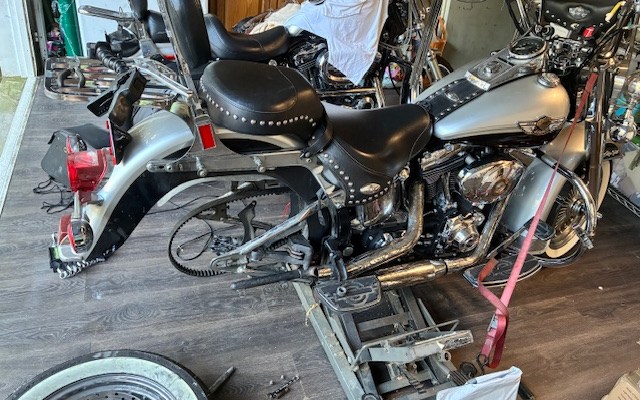
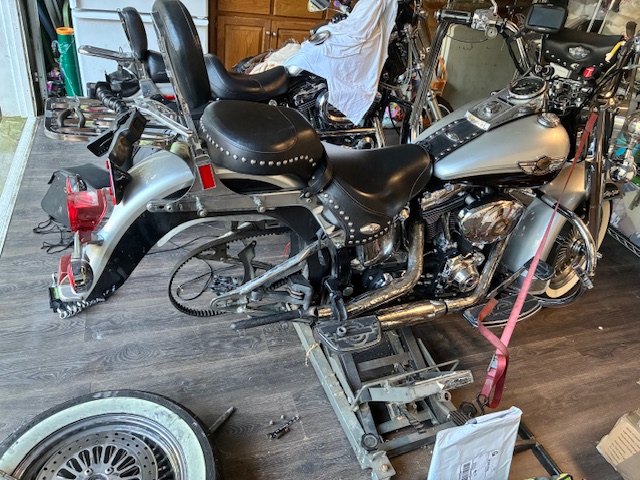
Ah yes—where was I before the narrative took a detour through the Land of Tangents? Right. Both bikes: temporarily out of commission. Not catastrophically, mind you—no fireballs, no dramatic oil geysers, no need to call in a hazmat team. Just the sort of mechanical malaise that leaves them sulking in the garage like disgruntled metal ponies.
Now, as of this very scribble, the brake pads for the Sportster have finally arrived. The delivery was courtesy of what I can only assume was the last surviving branch of the Pony Express, judging by the speed. Three days ago, the package landed with all the ceremony of a sacred relic, and I—being a man of action—promptly placed it on the garage floor next to the Sportster… where it has remained, untouched, like a shrine to good intentions.
Why the delay, you ask? Well, because I was elbow-deep—nay, shoulder-deep—in the guts of my beloved Heritage, performing what can only be described as “repair” in the same way that open-heart surgery is “routine maintenance.” Repair, you say? Oh, we’ll get there. Buckle up.
So there I was, fresh off a short ride that had gone suspiciously well—no explosions, no spontaneous combustion, not even a rogue squirrel. I parked the bike, took a few steps back to admire my trusty steed, and then noticed something. Something… off. A glint. A shimmer. A whisper from the universe saying, “Hey, you might want to squint at that.”
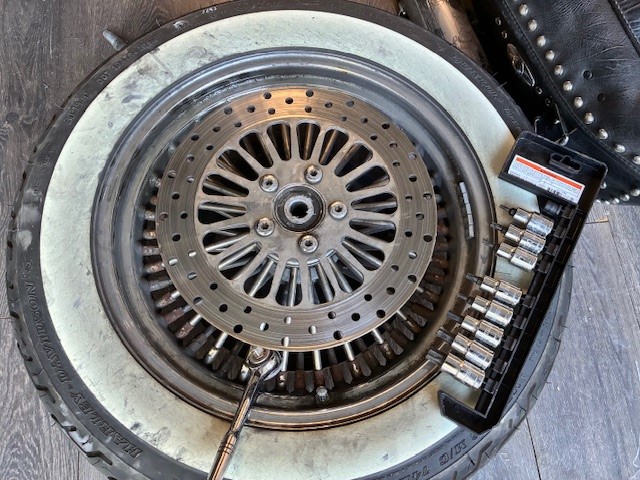
I squinted. I leaned in. And lo! A crack in the rear brake rotor, as if the cosmos had decided to play a practical joke involving metallurgy and mild peril. I had no idea how long it had been there—days? Weeks? Since the Big Bang?—but I figured it was best not to tempt fate or physics. So I did the sensible thing: I summoned the mighty JP Cycles website and ordered a new rotor with the solemn urgency of a man who’d just seen his brake system flirting with entropy.
Oddly enough, the rotor arrived before the brake pads, which felt like receiving the icing before the cake. But no matter—first-come, first-installed. I donned my ceremonial rubber gloves (because nothing says “serious mechanic” like latex), and plunged into the sacred rite of rear wheel removal, accompanied by the usual chorus of bolts, washers, swear words, and accouterments that always seem to multiply when you’re not looking.
I’ve performed this particular ritual at least six times since acquiring the bike—mostly for tire swaps, which are relatively benign affairs compared to the high-stakes drama of a rear rotor replacement. But when you only do something once in a blue moon (or every third lunar eclipse), the sacred sequence of steps tends to dissolve into the foggy hinterlands of the brain, right next to your high school locker combination and the lyrics to obscure ’80s jingles.
So naturally, I found myself fumbling through the process like a sleep-deprived archaeologist deciphering ancient runes. Tools were forgotten. Steps were skipped. The “Do This First” order became “Do Whatever Seems Least Likely to Cause a Fire.” Eventually, I surrendered to the oracle of all things mechanical: the service manual. A noble tome, battered and bruised, its pages now laminated with the fossilized fingerprints of past repairs. Sticky notes sprouted from its spine like neon-colored moss, and dog-eared corners bore cryptic labels—“Brakes,” “Fuel Injection,” “Specs”—each one a mocking reminder that I was about to be told to use tools I did not, in fact, possess.
Case in point: the elusive Star socket bit. The lead actor in this mechanical drama. I rummaged through the second drawer of my rolling toolbox, a place where sockets go to retire and breed confusion. SAE? Not quite. Metric? Tempting, but I knew better than to flirt with bolt-head destruction. So I did what any seasoned wrench-wielder would do—I phoned my brother, the keeper of obscure tool lore. He produced the correct star-bit like a wizard conjuring a spell component, and I returned to the task with renewed vigor. Well, not vigor exactly. More like determined grumbling.
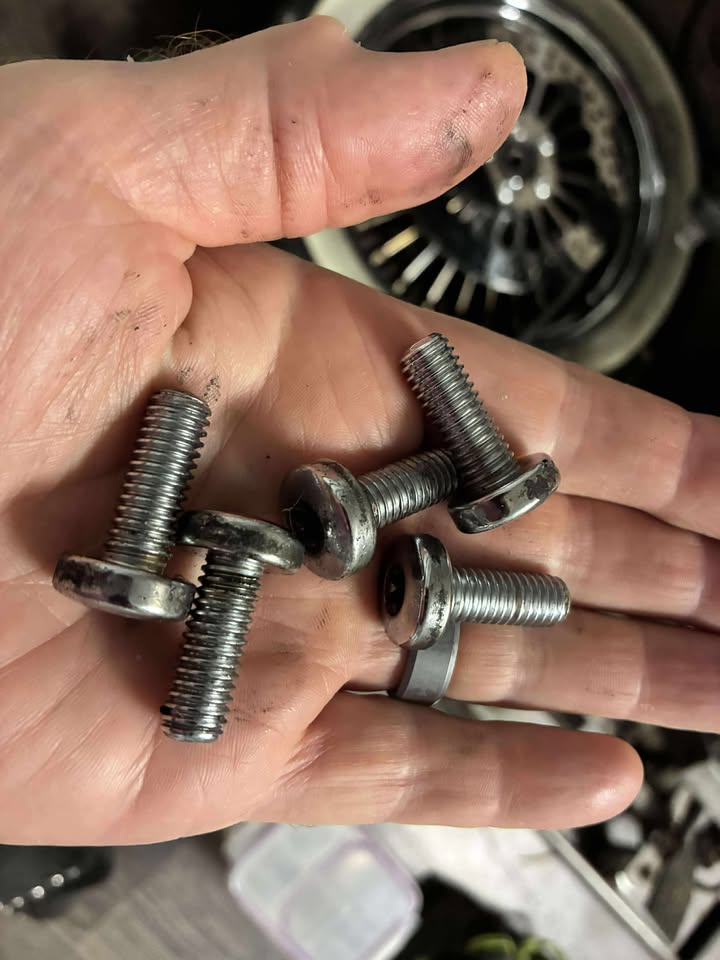
The aforementioned grumbling—and what passed for vigor in a man fueled by caffeine and mild resentment—was promptly put to the test. My noble quest to remove the 22-year-old bolts securing the ancient brake rotor to the wheel was, in practical terms, akin to attempting to levitate a rhinoceros using only a cocktail straw and sheer optimism.
I summoned the strength of three men and a boy (though in reality, it was mostly a slightly disgruntled hammer and an alarming amount of downward force). After much groaning, muttering, and a brief existential crisis, I managed to persuade the five bolts to relinquish their grip on the rotor. They did so reluctantly, like old retirees being evicted from their favorite pub.
Upon removal, the truth was revealed in all its Loctite-laden glory. The previous installer—almost certainly a Harley-Davidson line worker in 2003, at precisely 4:45 PM on a Friday, with one eye on the clock and the other on the weekend—had clearly decided that subtlety was for amateurs. Instead of a dab of threadlocker, they’d opted for the entire bottle. Possibly two. The result was a bond so unholy that even the USS Gerald R. Ford would struggle to break free from its moorings if tethered by these bolts. Frankly, I’m surprised the rotor hadn’t achieved sentience and applied for permanent residency.
Not wanting to re-use the old bolts with the sad history, I made the trek to my local Harley Dealership Parts department and purchased five new bolts, pre-lathered with the “that’ll do” amount of bolt-locking goo. Satisfied that I wouldn’t need to resort to any aggressive, no, violence to insert these little devils or tighten to the appropriate torque spec, which is something akin to 30 to 45 foot pounds and/or “that ain’t going nowhere” force. With significantly less vigor, almost hum-drum ineptitude, aided by a can of Coke, I cleaned the wheel with a mildly greasy rag, if for no other reason than to give the new rotor some sense of belonging with the fading chrome of the wheel. With the new rotor plopping into place almost magnetically, I inserted the new bolts and gave them the obligatory blessing of obscenities. Profanity, for all its uses, has a place in every toolbox.
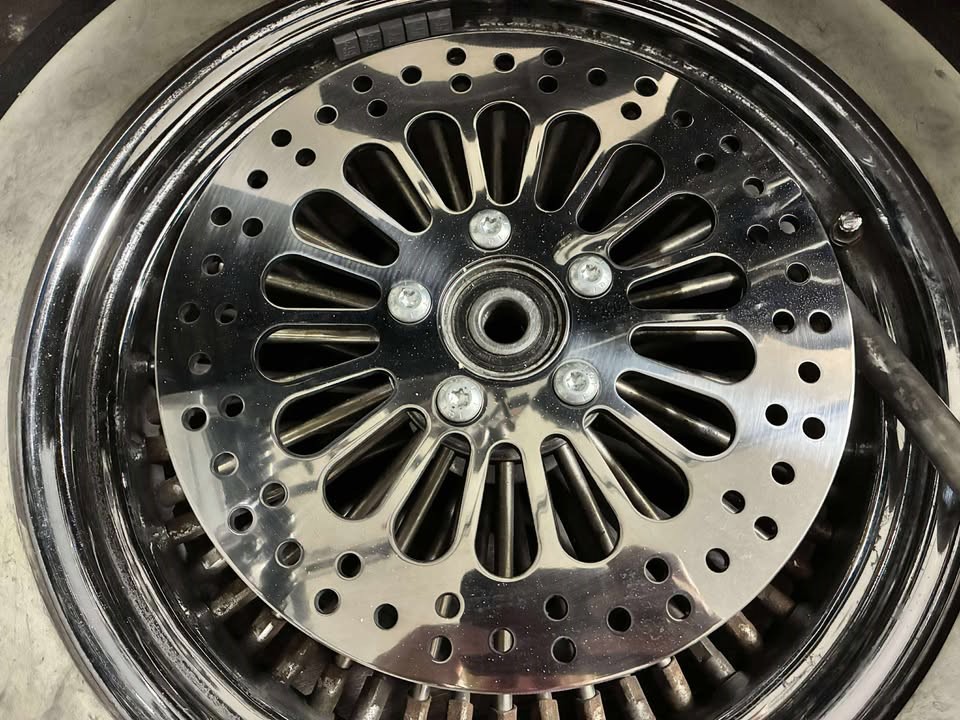
In the next episode….. I put it and the Sportster back together.
 Days I Ride